
Thrill Ride Manufacturer vs Supplier: Choosing a Project Partner
- How Manufacturer and Supplier Roles Differ in an Attraction Project
- What a direct manufacturer controls
- What a trading supplier typically provides
- Why accountability matters more than catalog size
- Procurement Criteria for High-Performance Amusement Park Rides
- Engineering and customization capability
- Safety documentation and conformity evidence
- Factory quality, testing, and traceability
- Project Delivery, Lifecycle Cost, and Return on Investment
- Site planning and installation responsibility
- Lifecycle cost is more than the purchase price
- Training and operational readiness
- Why SUNHONG Can Serve as a Complete Project Partner
- Integrated design, research, and manufacturing resources
- International documentation and project execution
- Customization backed by in-house expertise
- Frequently Asked Questions
- What is the main difference between a thrill ride manufacturer and a supplier?
- Should buyers choose a manufacturer for a customized attraction?
- Which safety standards should be reviewed during procurement?
- What documents should be requested before contract award?
- How can a buyer compare the real cost of two ride proposals?
- What does SUNHONG provide beyond ride manufacturing?
Choosing between a thrill rides amusement park manufacturer and a general supplier is a strategic decision that affects safety, project schedule, capital efficiency, guest experience, and long-term revenue. A manufacturer typically controls engineering, production, quality assurance, documentation, and technical support, while a supplier may primarily coordinate products from multiple factories. Project owners should evaluate design ownership, compliance evidence, customization capability, factory controls, installation resources, spare-parts availability, and lifecycle service before signing a contract. For complex attractions, the most reliable project partner is usually the organization that can accept clear technical responsibility from concept development through commissioning and after-sales support.
How Manufacturer and Supplier Roles Differ in an Attraction Project
What a direct manufacturer controls
A direct manufacturer develops or owns the core product technology and operates the facilities where major components are fabricated, assembled, tested, and documented. This structure gives buyers a clearer chain of accountability. Engineering changes can be reviewed by the design team, production issues can be addressed through internal quality procedures, and technical questions do not need to pass through several unrelated intermediaries.
For a large coaster, tower attraction, pendulum ride, spinning device, or family-thrill installation, manufacturing control is particularly important. Structural calculations, drive systems, restraint assemblies, braking arrangements, control logic, evacuation provisions, and passenger loading procedures must work as one integrated system. A manufacturer with in-house engineering and production personnel can generally coordinate these interfaces more effectively than a reseller dependent on separate factories.
What a trading supplier typically provides
A supplier may offer a broad catalog, competitive quotations, regional communication, and access to products from several producers. This model can be useful when a park needs standard equipment, replacement components, or a mixed procurement package. However, buyers must establish who owns the design, who validates the calculations, who controls the factory, and who remains responsible if an attraction does not perform according to the specification.
The lowest initial quotation can conceal additional costs for design revisions, site adaptation, customs coordination, installation supervision, training, replacement parts, or remedial work. A supplier should therefore be assessed not only as a sales channel but also as a project coordinator with demonstrable authority over its manufacturing partners.
Why accountability matters more than catalog size
Amusement ride procurement involves more than selecting a visually attractive product. The project must align attraction capacity with land use, local climate, power supply, queue design, emergency access, staffing, maintenance resources, and target visitor demographics. A partner that can connect these factors to a documented technical solution creates more value than a company that simply presents a large online catalog.
Buyers should request a responsibility matrix before contract award. It should identify the parties responsible for concept design, civil-interface information, structural engineering, electrical documentation, factory acceptance testing, shipping, installation, commissioning, operator training, inspections, and warranty response. This document exposes gaps that are often hidden in broad commercial proposals.
Procurement Criteria for High-Performance Amusement Park Rides
Engineering and customization capability
Customization should be evaluated as an engineering process rather than a cosmetic service. A capable project partner can adapt vehicle styling, color schemes, theming, capacity, restraint configuration, ride cycles, control interfaces, accessibility provisions, and site dimensions while preserving safety-critical performance. The partner should explain which elements are standard, which are configurable, and which require new validation.
Design reviews should cover load cases, fatigue exposure, wind conditions, seismic considerations where applicable, corrosion protection, drainage, foundation interfaces, maintenance access, and component replacement routes. Buyers should also ask for general arrangement drawings, utility schedules, operating envelopes, and interface data early enough for architects and civil contractors to coordinate the site.
Safety documentation and conformity evidence
Safety evidence should be specific to the supplied attraction and the destination market. Relevant documentation may include risk assessments, material certificates, weld inspection records, electrical schematics, control-system descriptions, inspection plans, operating manuals, maintenance manuals, and test reports. Certification marks alone are not a substitute for reviewing the technical file and confirming whether local authorities require additional inspection or approval.
International buyers can use recognized references such as ISO 17842 for safety of amusement rides and amusement devices, while North American projects may also consider applicable ASTM F2291 design and manufacture practices. European projects should verify applicable obligations through the European Commission guidance on CE marking. These references do not eliminate the need for jurisdiction-specific review, but they provide a structured basis for technical discussions.
Factory quality, testing, and traceability
Factory evaluation should examine incoming-material controls, welding procedures, non-destructive testing, dimensional inspection, coating systems, electrical testing, assembly tolerances, and document retention. A credible manufacturer should be able to explain how safety-critical components are identified and how nonconforming parts are isolated and corrected.
Factory acceptance testing should be defined in the purchase contract. The protocol may include unloaded cycles, loaded cycles, emergency-stop tests, sensor checks, restraint verification, braking performance, noise observations, control-system fault simulations, and inspection of accessible components. The acceptance record should identify test conditions, results, open items, responsible parties, and completion dates.
| Evaluation area | Direct manufacturer | General supplier | Buyer verification question |
|---|---|---|---|
| Product engineering | Usually controlled by an internal design team | May depend on an external factory | Who owns calculations and approves design changes? |
| Customization | Can often modify engineering and production parameters | May offer catalog-level modifications | Which changes require revalidation? |
| Quality assurance | Can provide factory process and inspection records | Evidence may come from a third party | Can the buyer audit the actual production site? |
| Installation | May deploy trained construction and commissioning teams | May subcontract site work | Who accepts responsibility for installation quality? |
| After-sales support | Direct access to technical and spare-parts resources | Support may pass through intermediaries | What is the response process for a critical failure? |
| Commercial risk | Fewer handoffs and clearer accountability | Potentially broader sourcing but more interfaces | Are warranty, payment, and escalation terms explicit? |
Project Delivery, Lifecycle Cost, and Return on Investment
Site planning and installation responsibility
Ride procurement should begin with site and operating assumptions, not only product images. The project team needs verified information about foundation loads, anchor positions, drainage, power requirements, transformer capacity, control rooms, access roads, crane plans, queue footprint, fencing, evacuation routes, and maintenance zones. A partner involved in amusement park design can help integrate the attraction into the wider master plan rather than treating it as an isolated machine.
Installation contracts should define the boundary between the ride contractor and local civil, electrical, architectural, and landscaping teams. They should also cover weather delays, lifting equipment, local labor, accommodation, commissioning conditions, authority inspections, punch-list closure, and handover documentation. Clear boundaries reduce schedule disputes and prevent critical tasks from being assumed by no party.
Lifecycle cost is more than the purchase price
Total cost of ownership includes shipping, duties, foundations, electrical infrastructure, installation, staffing, energy consumption, lubrication, inspections, consumables, spare parts, downtime, training, insurance, and eventual refurbishment. A ride with a lower purchase price may produce weaker returns if it has low hourly capacity, long dispatch intervals, difficult maintenance access, or limited spare-parts availability.
Revenue modeling should consider theoretical hourly capacity and realistic operating capacity. The realistic figure should account for loading time, unloading time, cleaning, operator rotation, weather interruptions, preventive maintenance, and temporary closures. Buyers should request assumptions behind capacity claims and test whether the proposed ride cycle is suitable for the park’s queue strategy and visitor profile.
Training and operational readiness
Operator training should include daily inspection, startup and shutdown, dispatch control, restraint checks, communication procedures, emergency response, evacuation, abnormal operating conditions, and incident reporting. Maintenance teams need structured instruction on lubrication points, wear limits, sensor replacement, troubleshooting, inspection intervals, and approved replacement parts.
A complete handover package should include operating manuals, maintenance schedules, electrical drawings, spare-parts lists, recommended tools, inspection forms, training records, warranty conditions, and escalation contacts. These documents support consistent operation and help the owner demonstrate due diligence to regulators, insurers, and internal safety teams.
Why SUNHONG Can Serve as a Complete Project Partner
Integrated design, research, and manufacturing resources
SUNHONG is a large-scale comprehensive amusement ride manufacturer dedicated to the research and development, design, manufacture, and sales of amusement rides. Our team supports overall planning, R&D design, exclusive customization, manufacturing, comprehensive construction, and operation management. This integrated model is designed to reduce handoffs between concept development, engineering, production, site execution, and commissioning.
Our product scope includes amusement park equipment, large-scale thrill attractions, family rides, children’s rides, water-related attractions, indoor entertainment equipment, and themed ride solutions. By combining product development with project planning, we can help buyers evaluate capacity, footprint, visual identity, guest flow, operational requirements, and maintenance access before the final equipment package is approved.
International documentation and project execution
With more than 10 years of export experience, SUNHONG has developed processes for international project communication, production coordination, packaging, shipping support, installation, and commissioning. Our amusement rides have been installed in more than 56 nations and regions. Export credentials include CE for the European Union, UKCA for the United Kingdom, SABER for Saudi Arabia, TUV-related German conformity services, and ASTM-related documentation for the United States, subject to the requirements of the specific project and jurisdiction.
These credentials should be reviewed alongside the actual technical documentation, destination-country rules, and authority requirements. Our approach is to provide buyers with the information needed for engineering coordination, inspection, customs preparation, installation planning, and operational handover rather than treating certification as a standalone sales claim.
Customization backed by in-house expertise
Our in-house experts in R&D, production, and construction provide support from the initial concept to final project completion. For investors and park operators, this means a single technical conversation can address ride appearance, structural interfaces, control requirements, production feasibility, installation sequencing, and post-opening support.
SUNHONG’s goal is to become the world’s leading manufacturer of amusement rides. Buyers evaluating a long-term partner should compare this integrated capability with the risks of purchasing through multiple disconnected channels. The right partner is not necessarily the company offering the shortest quotation; it is the organization that can demonstrate consistent engineering control, transparent documentation, practical site support, and responsive lifecycle service.
Frequently Asked Questions
What is the main difference between a thrill ride manufacturer and a supplier?
A manufacturer typically controls engineering, production, quality assurance, technical documentation, and direct support, while a supplier may coordinate products made by one or more external factories. Buyers should confirm who owns the design and who accepts responsibility for performance, compliance, installation, and warranty service.
Should buyers choose a manufacturer for a customized attraction?
For a customized attraction, a manufacturer is often better positioned to adapt engineering, production parameters, control systems, theming, capacity, and site interfaces while coordinating the required validation. Buyers should still confirm which proposed changes are standard and which require additional testing or approval.
Which safety standards should be reviewed during procurement?
Buyers can use ISO 17842 as an international reference for amusement ride safety, ASTM F2291 for applicable North American design and manufacture practices, and European Commission CE-marking guidance for relevant European obligations. Local authority requirements and project-specific technical review remain necessary.
What documents should be requested before contract award?
Important documents may include general arrangement drawings, foundation and utility data, risk assessments, material and weld records, electrical schematics, inspection plans, operating manuals, maintenance manuals, test procedures, spare-parts lists, warranty terms, and a responsibility matrix.
How can a buyer compare the real cost of two ride proposals?
The comparison should include purchase price, shipping, duties, foundations, utilities, installation, training, energy use, inspections, spare parts, maintenance, expected downtime, and refurbishment. Capacity assumptions should also be tested against actual loading time, operating hours, staffing, weather, and preventive maintenance requirements.
What does SUNHONG provide beyond ride manufacturing?
SUNHONG provides overall planning, R&D design, exclusive customization, manufacturing, comprehensive construction, operation management, export support, installation, commissioning, and lifecycle assistance through in-house R&D, production, and construction teams.
Contact SUNHONG at sunhong@isunhong.com or visit https://www.isunhong.com/ to discuss amusement park equipment, custom ride manufacturing, and complete project delivery.
Top 10 amusement park rides Manufacturers and Supplier Brands in China
Total cost of ownership calculator inputs and examples
Best professional amusement attractions manufacturers and supplier brands in US
International export success story: crossing regulatory boundaries
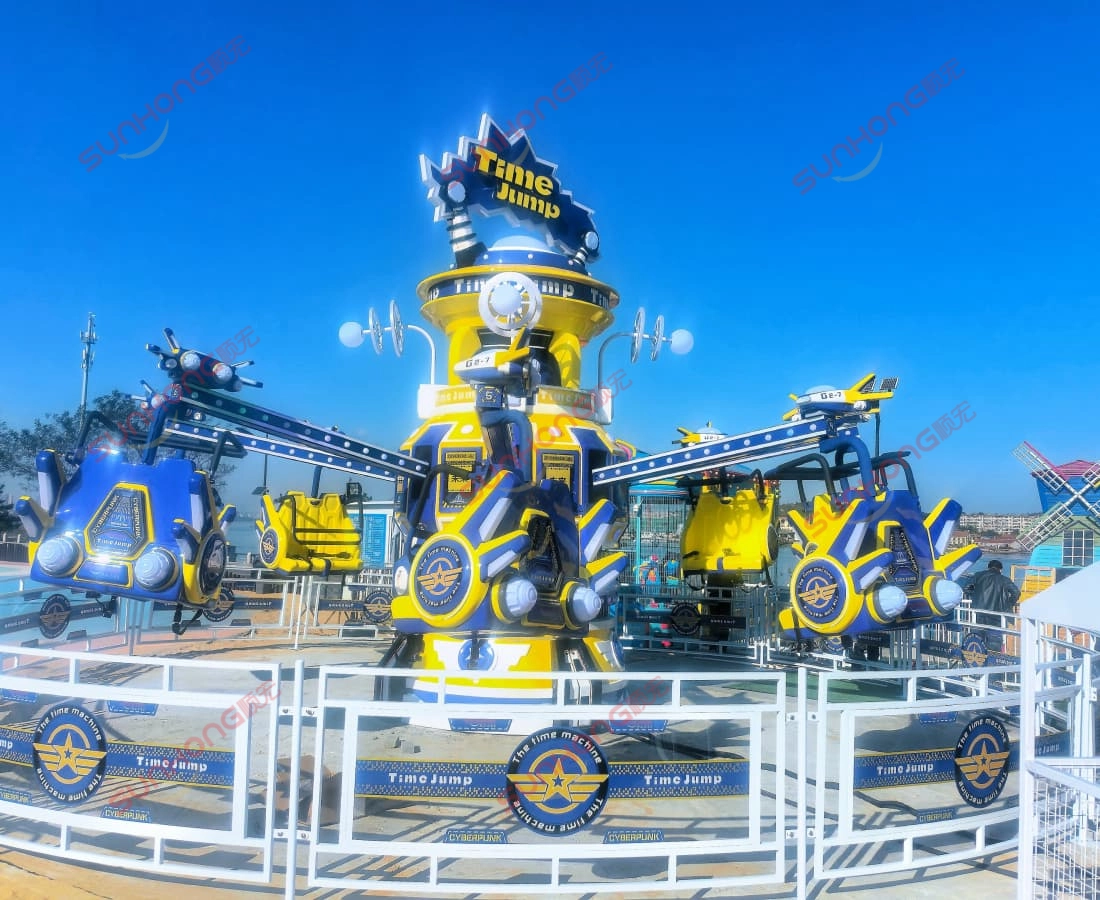
16-Seat Time Jump – Rotating Plane Ride for Amusement Parks
Time Jump is a thrilling and cost-effective amusement ride, 100% originally developed and manufactured by SUNHONG with patented certification. Designed for families and children, it combines motor drive and air-compressor cylinders to achieve dynamic movements—left-right rotation, variable-speed spinning, bouncing seats, and full 360-degree spins.
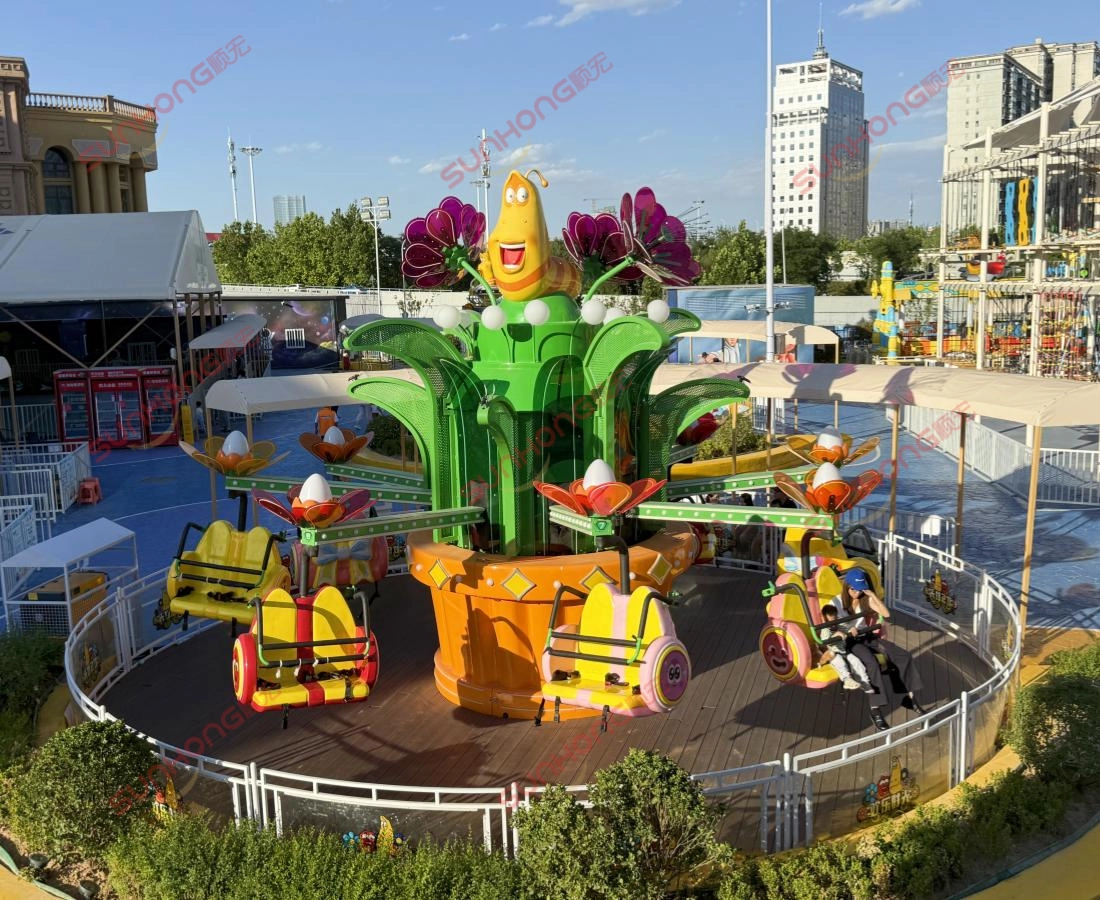
Larva Blooms Bounce Ride – Hot IP Custom Attraction with 360° Spin & Bounce
Larva Blooms is a patented bounce ride inspired by the hit Larva animation series. Featuring full platform rotation, 360° spinning seats, and dynamic bouncing motion, it delivers a thrilling ride experience for families and kids. IP customization available with OEM/ODM service.
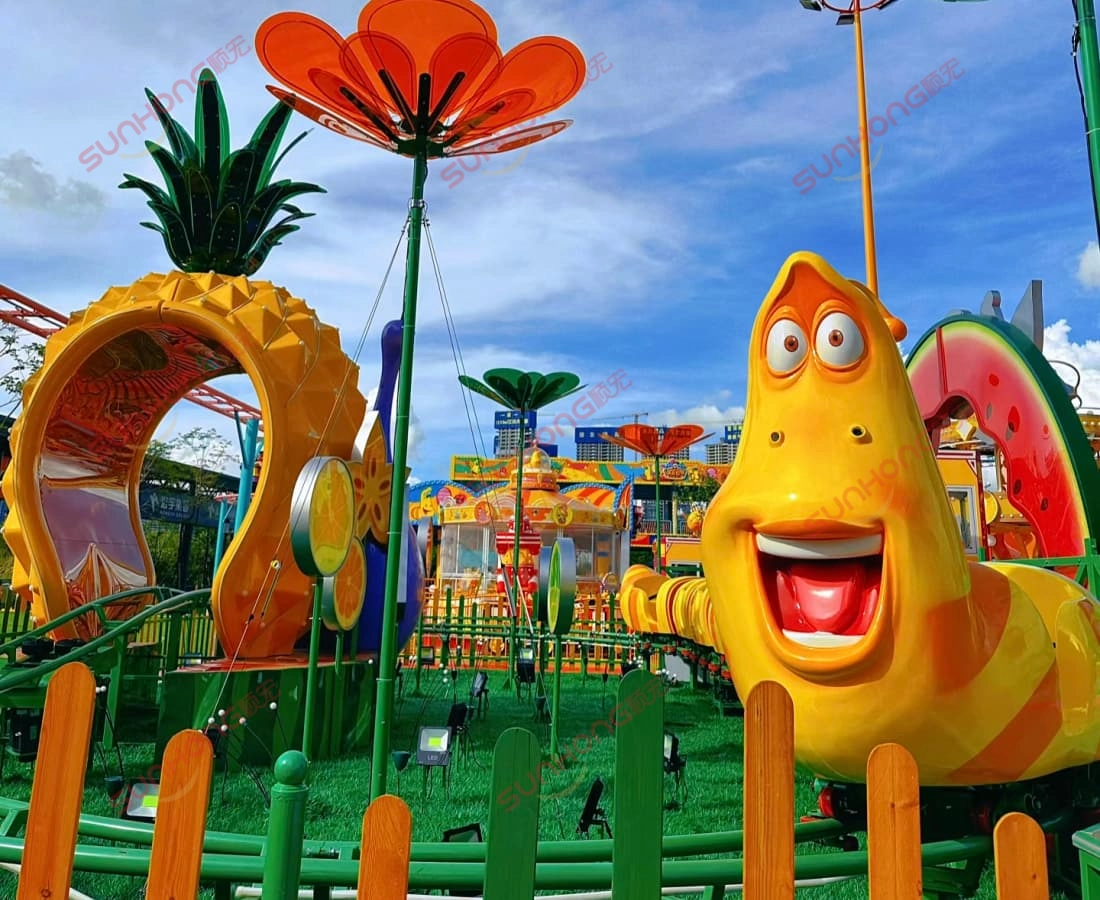
Larva Fruitland – A Mini Roller Coaster Adventure for Kids and Families
Larva Fruitland is a mini roller coaster themed after the Larva animated series. With vibrant colors and gentle motion, it’s perfect for kids and families. This small coaster features IP characters, a fruit farm design, and photo-worthy appeal. Ideal for indoor or outdoor parks. OEM/ODM customization available for your branding needs.

360 Degree Rotating Ride Swing Thrill Amusement Rides for Attractions
Air Bus is a stunning addition to our family amusement rides, delivering a one-of-a-kind 360° dual-rotation experience. With its swinging arm and self-spinning cabin, bright yellow flying-bus design, dynamic music effects, and customizable options, this ride is more than just entertainment—it’s a show-stopping centerpiece that helps your park attract crowds.
Leave a message
Ready to elevate your amusement offerings?
Contact Sunhong today to explore how we can bring your vision to life and create unforgettable experiences for your visitors.
* Rest assured that your privacy is important to us, and all information provided will be handled with the utmost confidentiality.
Copyright © 2025 SUNHONG All Reserved.
Whatsapp: +8613922331804
Guangzhou Shunhong Entertainment Equipment Co.,Ltd.
sunhongrides
SUNHONGAMUSEMENTRIDES
Scan QR Code