
Outdoor Theme Park Rides: Comparing Steel, Fiberglass, and Theming
- Material Strategy for Outdoor Amusement Attractions
- Steel for primary structure and repeated operating loads
- Fiberglass for lightweight forms and guest-facing components
- Theming as an operational and commercial layer
- How Buyers Should Compare Outdoor Ride Systems
- Climate, site conditions, and foundation requirements
- Safety documentation and regulatory readiness
- Lifecycle cost, capacity, and guest experience
- Integrated Project Delivery with SUNHONG
- From concept development to manufactured equipment
- Manufacturing control, documentation, and international delivery
- Construction support and long-term operating value
- Procurement Checklist for a Durable Themed Attraction
- Questions to resolve before contract signing
- How to protect return on investment
- Frequently Asked Questions
Outdoor theme park rides are long-term capital assets, not simply visual attractions purchased by appearance. Their performance depends on how the load-bearing frame, passenger-contact surfaces, weatherproof enclosure, control system, foundations, queue environment, and narrative elements work together. For investors and park operators, the material decision affects structural safety, fabrication cost, installation time, inspection access, lifecycle maintenance, ride capacity, and brand differentiation. Steel, fiberglass, and themed finishes each solve a different engineering or commercial problem, so the strongest procurement strategy is usually a coordinated material system rather than a single-material specification.
Material Strategy for Outdoor Amusement Attractions
Steel for primary structure and repeated operating loads
Steel remains the dominant material for support towers, track systems, frames, platforms, rotating assemblies, columns, and other components exposed to repeated operational forces. Its advantages include high strength, predictable fabrication, weldable sections, broad availability, and compatibility with established structural calculation methods. Roller coasters, observation rides, large pendulum attractions, carousels, and many family rides depend on steel for their core mechanical and structural architecture.
However, steel performance is inseparable from corrosion control. Outdoor installations face rain, humidity, ultraviolet exposure, condensation, salt air, dust, and chemical contaminants. Buyers should therefore specify surface preparation, coating systems, galvanizing where appropriate, drainage provisions, enclosed-section protection, fastener grades, weld inspection, and a documented repainting or touch-up program. A low purchase price can become expensive when hidden corrosion, water retention, difficult access, or premature coating failure increases downtime.
Fiberglass for lightweight forms and guest-facing components
Fiberglass-reinforced plastic, commonly called FRP, is frequently used for vehicle bodies, animal figures, decorative panels, tunnel liners, façade elements, themed roofs, water-ride scenery, and sculptural components. Its relatively low weight supports complex shapes without the mass of an equivalent solid metal form. Molds can reproduce repeated parts consistently, while hand finishing or CNC-assisted tooling can support custom designs for a park’s intellectual property or local cultural theme.
FRP does not replace structural engineering. Panels, shells, and decorative housings must be supported, secured, and designed for wind, vibration, impact, thermal movement, and maintenance access. Buyers should ask about laminate schedules, resin selection, gelcoat thickness, UV stabilization, fire-performance requirements, attachment points, repair procedures, and color matching for replacement parts. A visually impressive shell can underperform if water enters through joints, fasteners loosen under vibration, or the finish fades in a high-sun environment.
Theming as an operational and commercial layer
Theming includes rockwork, façades, scenic painting, signage, lighting integration, landscaping interfaces, sound zones, queue storytelling, character elements, and architectural details that transform a ride into an experience. It influences perceived value, guest photography, dwell time, merchandise potential, and the ability to build a recognizable destination rather than a collection of unrelated machines.
Theme design should be developed alongside ride engineering. Decorative walls can obstruct evacuation routes, conceal inspection points, interfere with ventilation, create water traps, or limit access to motors and control cabinets. A practical scenic package separates removable panels from permanent structures, provides concealed but reachable service doors, manages drainage, protects electrical equipment, and defines cleaning methods. Narrative design is strongest when it supports capacity and circulation instead of adding operational friction.
| Decision factor | Steel | Fiberglass | Themed finishes | Buyer implication |
|---|---|---|---|---|
| Primary function | Load-bearing frames and mechanical assemblies | Lightweight shells, panels, and sculptural forms | Guest immersion and visual identity | Use each material according to its engineering role |
| Typical maintenance concern | Corrosion, coating damage, welds, and fatigue inspection | UV aging, cracking, impact damage, and joint degradation | Fading, water ingress, surface wear, and access obstruction | Specify inspection and renewal procedures before purchase |
| Design strength | High structural capacity and repeatable fabrication | Complex geometry with comparatively low mass | Storytelling, differentiation, and photo appeal | Evaluate lifecycle value, not only initial appearance |
| Procurement priority | Engineering calculations, weld quality, coatings, and compliance | Material specification, mold quality, attachment, and repairability | Fire, accessibility, drainage, lighting, and service integration | Require coordinated drawings and interface responsibilities |
How Buyers Should Compare Outdoor Ride Systems
Climate, site conditions, and foundation requirements
Material selection should begin with the site rather than the catalog image. Coastal parks may require enhanced corrosion protection and stainless or specially protected hardware. Tropical locations must account for intense rainfall, mold, drainage, and high humidity. Cold regions introduce freeze-thaw movement, snow accumulation, and seasonal shutdown procedures. High-wind sites require confirmation of wind design criteria for both operating and non-operating conditions, especially where large fiberglass façades or themed roofs increase exposed area.
Geotechnical information is equally important. Soil bearing capacity, groundwater, seismic conditions, settlement risk, and existing utilities affect foundation design and installation cost. A supplier should define the boundary between ride supply and civil works, provide anchor-bolt layouts, identify concrete tolerances, and communicate utility loads early. Ambiguous interface documents are a frequent cause of delay between the ride manufacturer, civil contractor, electrical contractor, and local authority.
Safety documentation and regulatory readiness
Safety compliance is a project process, not a certificate added at shipment. The relevant requirements depend on the destination, ride category, electrical system, construction rules, and inspection authority. The ISO 17842 amusement rides and amusement devices standard provides an internationally recognized framework covering design, manufacture, operation, and maintenance concepts. In the United States, buyers may also need to consider applicable requirements and guidance from the ASTM F24 committee on amusement rides and devices.
Procurement teams should request risk assessments, structural calculations, electrical schematics, control descriptions, emergency-stop logic, evacuation procedures, operating manuals, maintenance schedules, spare-parts lists, and inspection records. The U.S. Consumer Product Safety Commission amusement ride safety information also illustrates why operator training, reporting, and jurisdiction-specific oversight matter. Compliance responsibilities should be assigned in the contract, including who manages third-party inspection, local permits, commissioning tests, and final acceptance.
Lifecycle cost, capacity, and guest experience
The lowest factory quotation is not necessarily the lowest project cost. A robust comparison should include shipping volume, foundation complexity, erection equipment, installation labor, commissioning, spare parts, coating renewal, scenic replacement, energy consumption, staffing, downtime, and eventual refurbishment. Capacity and dispatch time deserve equal attention. A visually elaborate attraction that loads slowly or requires frequent manual intervention may deliver less revenue than a simpler ride with dependable throughput.
Guest experience should be measured through more than thrill intensity. Shade, queue comfort, accessibility, visibility, sound levels, nighttime lighting, photo opportunities, and weather resilience influence satisfaction. The best amusement park design aligns the ride cycle with the park’s demographic, land area, climate, ticket strategy, and expected peak attendance. A family attraction may generate stronger all-day utilization than a highly specialized thrill ride if the target market includes mixed-age groups.
Integrated Project Delivery with SUNHONG
From concept development to manufactured equipment
SUNHONG is a large-scale comprehensive amusement ride manufacturer dedicated to research and development, design, manufacture, and sales. Our team supports overall planning, R&D design, exclusive customization, manufacturing, comprehensive construction, operation management, and related project services. This integrated capability helps project owners coordinate the ride mechanism, steel structure, fiberglass elements, thematic environment, controls, guest circulation, and installation requirements through a clearer technical workflow.
Our product scope includes amusement park equipment and customized amusement park rides for different site sizes, market positions, and visitor profiles. Depending on the brief, our engineering and design teams can help define a family attraction, thrill ride, observation experience, water-related installation, children’s ride, or themed scenic system. The objective is to match the attraction with capacity targets, available land, local climate, investment budget, and the operator’s long-term maintenance resources.
Manufacturing control, documentation, and international delivery
Our in-house experts in R&D, production, and construction provide a project path from initial concept to final completion. This structure can reduce communication gaps between design intent and fabrication details, particularly where steelwork, fiberglass shells, lighting, sound, and scenic components must connect precisely. Production reviews should verify dimensions, welds, surface treatment, mechanical assemblies, finishing quality, packing protection, and installation references before dispatch.
With more than 10 years of export experience, SUNHONG holds certificates and market-entry qualifications for destinations including CE for the European Union, UKCA for the United Kingdom, SABER for Saudi Arabia, TUV certification in Germany, and ASTM certification for the United States, subject to the specific product and project requirements. Buyers should still confirm the exact applicable standards and approval pathway with local authorities, because certification scope and inspection obligations vary by jurisdiction.
Construction support and long-term operating value
SUNHONG provides reach global services, with amusement rides installed in more than 56 nations and regions. International delivery is not limited to shipping equipment; it can involve installation coordination, commissioning support, operator guidance, maintenance documentation, and communication with project stakeholders. For investors, this broader service model is valuable when local teams need clear procedures for daily checks, preventive maintenance, troubleshooting, spare-parts planning, and seasonal preparation.
Our goal is to become the world’s leading manufacturer of amusement rides by combining technical development with dependable project execution. For a park owner, that ambition should translate into measurable project controls: clear specifications, responsive engineering communication, traceable production, realistic delivery milestones, practical manuals, and support after opening. The final selection should be based on verified capability and fit for the site, not on decorative renderings alone.
Procurement Checklist for a Durable Themed Attraction
Questions to resolve before contract signing
Buyers should establish the intended audience, expected hourly capacity, operating season, daily cycles, land constraints, height limits, climate exposure, local authority requirements, and available maintenance staff. The request for quotation should identify whether the supplier is responsible for concept design, detailed engineering, civil interfaces, theming, controls, installation, training, commissioning, and documentation. It should also define acceptance criteria for noise, speed, capacity, finish quality, water management, lighting, and ride availability.
- Request a material schedule identifying structural steel grades, coating systems, fiberglass specifications, sealants, fasteners, and replaceable scenic parts.
- Require coordinated general arrangement, foundation, electrical, evacuation, drainage, and maintenance-access drawings.
- Confirm inspection points for welding, non-destructive testing where applicable, coating thickness, dimensional accuracy, and factory testing.
- Review spare-parts availability, warranty exclusions, response times, recommended inventory, and planned refurbishment intervals.
- Verify that accessibility, fire protection, emergency egress, operator sightlines, and guest separation are addressed in the layout.
How to protect return on investment
A reliable business case links capital expenditure with attendance potential, throughput, operating hours, staffing, ticket or admission strategy, secondary spending, maintenance cost, and downtime risk. Theming can increase perceived exclusivity and social-media visibility, but it should be prioritized around guest touchpoints and high-traffic sightlines rather than applied uniformly without a commercial purpose. Durable materials, replaceable panels, accessible service areas, and standardized components often produce better long-term value than fragile details that are difficult to repair.
For project owners comparing suppliers, a structured scorecard is more useful than a single price ranking. Weight engineering competence, compliance documentation, delivery record, installation resources, customization ability, lifecycle support, and total cost of ownership. SUNHONG can be contacted at sunhong@isunhong.com, and its product and project information is available at the SUNHONG official website.
Contact SUNHONG to evaluate a customized amusement park ride, integrated amusement park equipment package, or complete amusement park design for your next outdoor destination.
Frequently Asked Questions
Is steel or fiberglass better for outdoor theme park rides?
Neither material is universally better because each serves a different role. Steel is generally suited to primary load-bearing frames and mechanical assemblies, while fiberglass is useful for lightweight shells, panels, vehicle bodies, and sculptural features. A coordinated system normally provides the best balance of strength, weight, appearance, and maintenance.
How can buyers protect outdoor rides from corrosion?
Buyers should specify suitable surface preparation, protective coating systems, drainage, protected enclosed sections, appropriate fasteners, weld inspection, and a documented repainting or touch-up program. Coastal, humid, rainy, and chemically exposed sites may require enhanced protection and more frequent inspections.
What documents should an amusement ride supplier provide?
A procurement package should normally address risk assessments, structural calculations, electrical schematics, control descriptions, emergency-stop logic, evacuation procedures, operating manuals, maintenance schedules, spare-parts lists, inspection records, foundation drawings, and commissioning documentation. Exact requirements depend on the destination and local authority.
Does fiberglass require regular maintenance outdoors?
Yes. Fiberglass components should be checked for UV aging, fading, cracking, impact damage, loose joints, water ingress, sealant deterioration, and attachment problems. Buyers should also confirm the laminate and gelcoat specifications, repair method, replacement availability, and color-matching process.
How does theming affect ride operations?
Theming can improve immersion, guest engagement, photo appeal, and destination differentiation, but poorly coordinated scenery may obstruct evacuation routes, conceal inspection points, restrict ventilation, create water traps, or limit access to motors and controls. Removable panels, service doors, drainage, and clear maintenance zones should be designed from the beginning.
What should be included in a total cost comparison between ride suppliers?
The comparison should include equipment price, shipping volume, foundations, erection equipment, installation labor, commissioning, spare parts, coating renewal, scenic replacement, energy use, staffing, downtime, maintenance, and refurbishment. Capacity, dispatch time, operating season, and expected guest demand should also be included in the business case.
ISO and other quality management system implementation
Integrating show systems: animatronics, lighting, and sound
Wholesale theme park equipment manufacturer and supplier
Playground Equipment Solutions for Real Estate Developers and Residential Communities
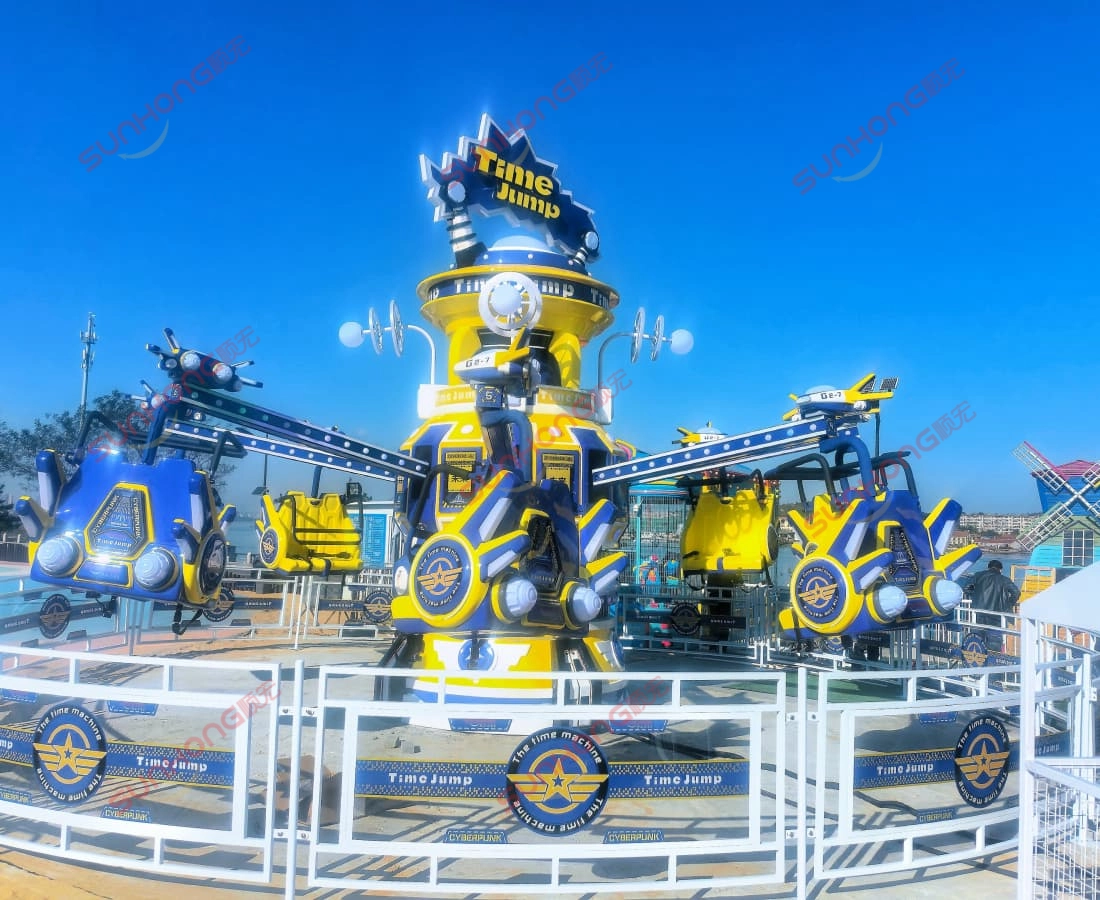
16-Seat Time Jump – Rotating Plane Ride for Amusement Parks
Time Jump is a thrilling and cost-effective amusement ride, 100% originally developed and manufactured by SUNHONG with patented certification. Designed for families and children, it combines motor drive and air-compressor cylinders to achieve dynamic movements—left-right rotation, variable-speed spinning, bouncing seats, and full 360-degree spins.
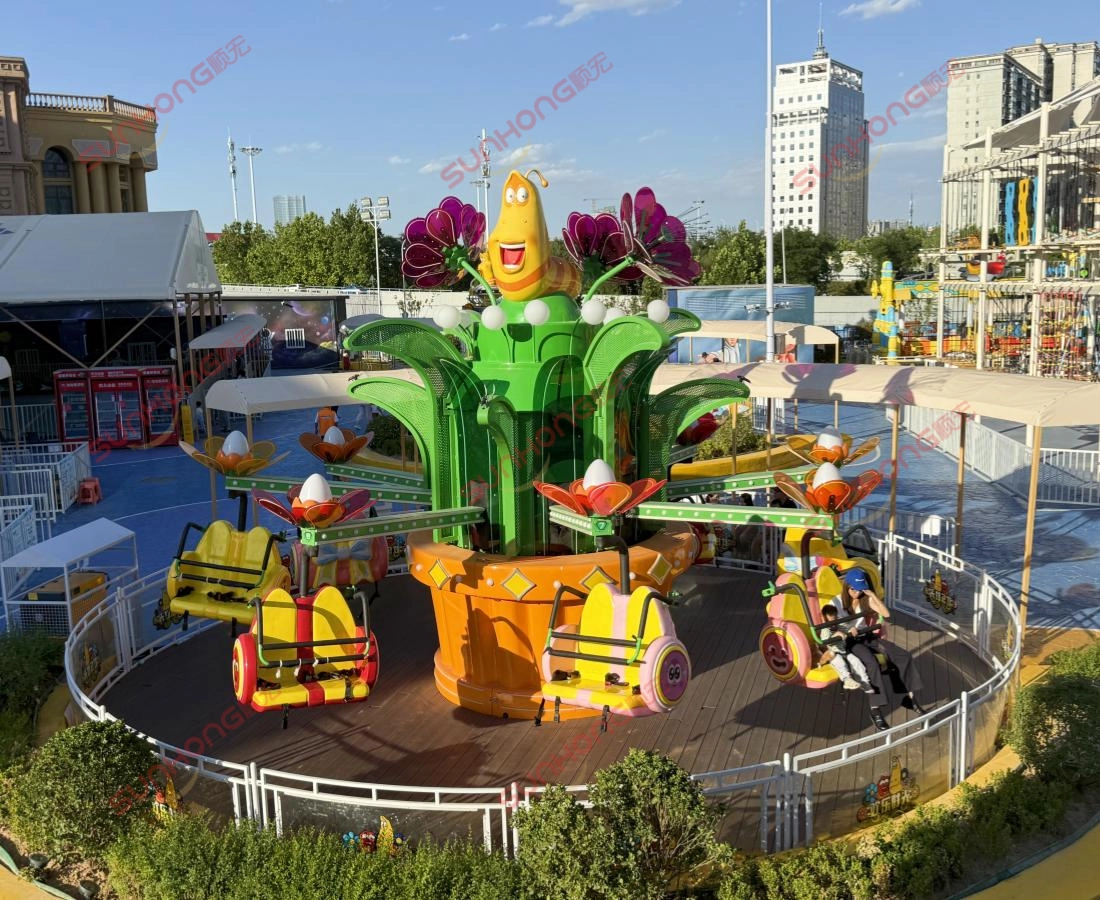
Larva Blooms Bounce Ride – Hot IP Custom Attraction with 360° Spin & Bounce
Larva Blooms is a patented bounce ride inspired by the hit Larva animation series. Featuring full platform rotation, 360° spinning seats, and dynamic bouncing motion, it delivers a thrilling ride experience for families and kids. IP customization available with OEM/ODM service.
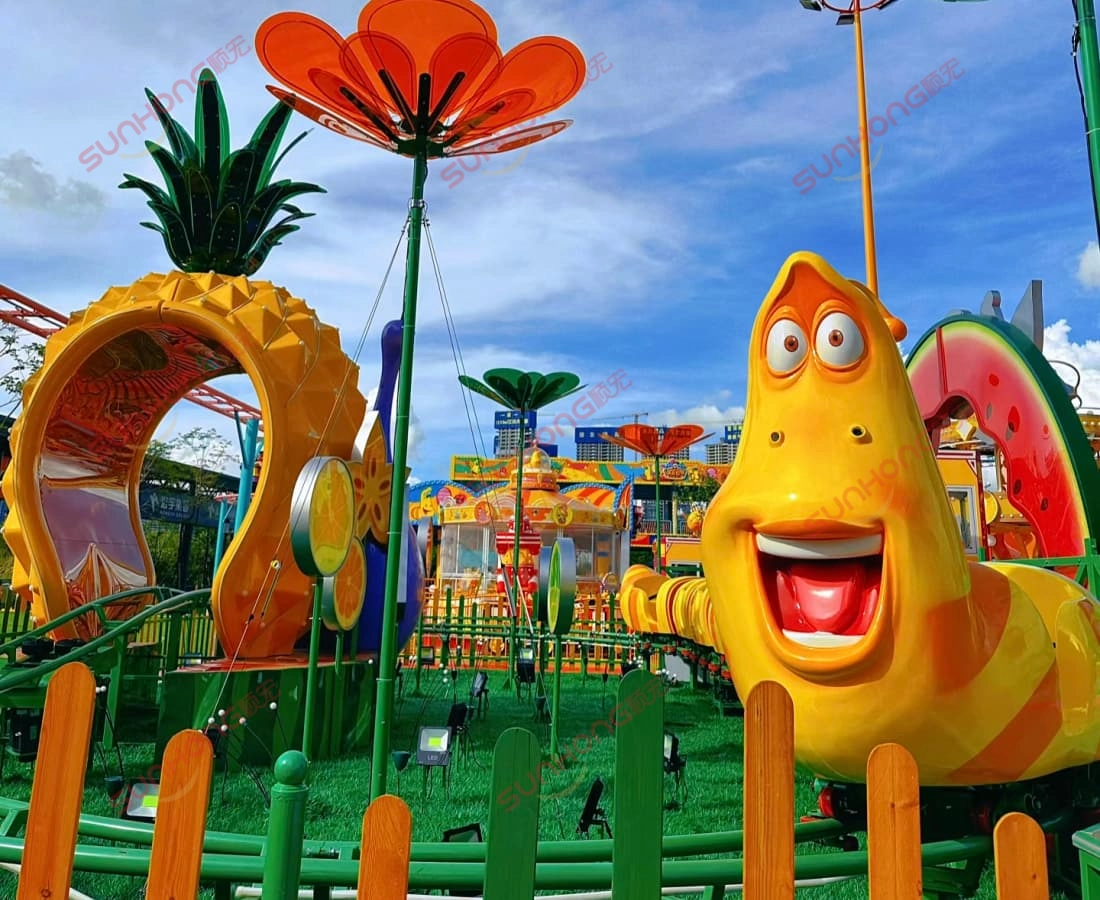
Larva Fruitland – A Mini Roller Coaster Adventure for Kids and Families
Larva Fruitland is a mini roller coaster themed after the Larva animated series. With vibrant colors and gentle motion, it’s perfect for kids and families. This small coaster features IP characters, a fruit farm design, and photo-worthy appeal. Ideal for indoor or outdoor parks. OEM/ODM customization available for your branding needs.

360 Degree Rotating Ride Swing Thrill Amusement Rides for Attractions
Air Bus is a stunning addition to our family amusement rides, delivering a one-of-a-kind 360° dual-rotation experience. With its swinging arm and self-spinning cabin, bright yellow flying-bus design, dynamic music effects, and customizable options, this ride is more than just entertainment—it’s a show-stopping centerpiece that helps your park attract crowds.
Leave a message
Ready to elevate your amusement offerings?
Contact Sunhong today to explore how we can bring your vision to life and create unforgettable experiences for your visitors.
* Rest assured that your privacy is important to us, and all information provided will be handled with the utmost confidentiality.
Copyright © 2025 SUNHONG All Reserved.
Whatsapp: +8613922331804
Guangzhou Shunhong Entertainment Equipment Co.,Ltd.
sunhongrides
SUNHONGAMUSEMENTRIDES
Scan QR Code