
Outdoor Theme Park Rides Quality Control: Tests and Certifications
- How Safety Assurance Works for Outdoor Amusement Attractions
- Risk assessment begins before fabrication
- Structural and mechanical verification
- Electrical, control, and emergency-system validation
- Testing and Certification Stages Buyers Should Require
- Factory acceptance testing before shipment
- Site acceptance and commissioning
- Certification is market-specific
- How to Evaluate a Reliable Ride Manufacturing Partner
- Documentation and traceability as procurement criteria
- Lifecycle cost matters more than purchase price
- SUNHONG project capabilities
- Useful external safety references
- Operational Quality Control After Opening
- Daily checks and preventive maintenance
- Weather, modification, and change management
- Training and records protect the investment
- Frequently Asked Questions
Outdoor theme park rides quality control is a multi-stage process covering concept engineering, structural analysis, material selection, welding, mechanical assembly, electrical systems, factory testing, site commissioning, and operational documentation. A qualified outdoor theme park rides builder should provide traceable inspection records and demonstrate compliance with the rules of the destination market rather than relying on a single certificate. For buyers of amusement park equipment, the most important evidence includes risk assessments, load calculations, non-destructive testing reports, control-system verification, emergency-stop testing, installation records, operator manuals, and independent or authority inspections. SUNHONG combines amusement park design, ride manufacturing, construction, and international project support to help investors reduce safety risk, approval delays, and lifecycle maintenance costs.
How Safety Assurance Works for Outdoor Amusement Attractions
Risk assessment begins before fabrication
Quality control should begin during the feasibility and design stage, not after a ride has been manufactured. The project team should identify foreseeable hazards associated with acceleration, rotation, elevation, falling objects, entrapment, collision, fire, weather exposure, power failure, unauthorized access, and passenger misuse. The risk assessment should connect each hazard to a specific design control, inspection point, operating rule, or maintenance task.
For example, a family coaster may require restraint verification, braking-distance analysis, evacuation access, anti-rollback protection, and a controlled restart sequence after a power interruption. A large observation wheel introduces different concerns, including wind loading, drive redundancy, cabin locking, bearing condition, overspeed protection, and rescue planning. Treating every attraction as a generic product can leave important hazards undocumented.
European projects commonly reference the safety principles and conformity framework applicable to machinery and amusement devices, while North American projects may require alignment with ASTM F24 practices and local authority requirements. Buyers should review the current legal obligations in the installation country and confirm which standards are mandatory, contractually specified, or used as recognized technical guidance. The ISO 12100 machinery safety framework is a useful reference for systematic hazard identification and risk reduction, although it does not replace ride-specific regulations or local approval.
Structural and mechanical verification
Primary steel structures, platforms, columns, tracks, axles, shafts, bearings, welds, foundations, and restraint components must be assessed for static loads, dynamic loads, fatigue, vibration, corrosion, and abnormal operating conditions. Engineering teams normally use load cases that account for passenger weight, vehicle or gondola mass, braking forces, wind, temperature variation, seismic conditions where relevant, and simultaneous loading scenarios.
Material certificates should identify the grade, heat number, supplier, and applicable mechanical properties. Traceability is especially important for load-bearing members and safety-critical components because substitution with an unapproved material can invalidate the original calculation. Weld inspection may include visual examination, dimensional checks, dye penetrant testing, magnetic particle testing, ultrasonic testing, or radiographic testing, depending on the component and the approved inspection plan.
Mechanical testing must also verify alignment, clearances, fastening torque, lubrication, gear engagement, brake response, restraint locking, and abnormal-condition behavior. A supplier should define acceptance criteria before testing begins. This prevents subjective decisions such as accepting excessive vibration because the ride appears to operate normally during a brief demonstration.
Electrical, control, and emergency-system validation
Modern amusement rides depend on programmable controls, sensors, variable-frequency drives, safety relays, interlocks, communication systems, and supervisory monitoring. Quality control therefore extends beyond the visible steelwork. Engineers should validate sensor positioning, fail-safe logic, software versions, input and output mapping, access-door interlocks, overspeed detection, brake monitoring, and safe-state behavior after a communication or power fault.
Emergency-stop buttons should be tested from every relevant operating position, and the resulting shutdown must be measured and documented. The test should confirm that hazardous motion stops within the defined limit, stored energy is controlled, and the attraction cannot restart without an authorized reset procedure. Evacuation lighting, public-address systems, backup power, fire protection interfaces, and rescue access should be included in the commissioning checklist.
Electrical conformity depends on the destination country and equipment configuration. A CE marking pathway in Europe, UKCA requirements in the United Kingdom, or local certification and registration in other markets may involve different documentation. Buyers should distinguish between a legitimate conformity assessment and a marketing statement that has no supporting technical file.
Testing and Certification Stages Buyers Should Require
Factory acceptance testing before shipment
Factory acceptance testing, commonly called FAT, provides an opportunity to identify defects while the ride remains in the manufacturer’s controlled environment. The inspection should cover dimensions, surface treatment, weld quality, fastener installation, rotation or travel performance, brakes, restraints, electrical cabinets, control logic, alarms, emergency stops, and communications. For attractions shipped in sections, the manufacturer should conduct a trial assembly or dimensional verification to reduce installation surprises.
The FAT package should include approved drawings, parts lists, material records, calibration certificates for measuring instruments, test results, non-conformance reports, corrective-action records, and photographic evidence where useful. A buyer or appointed inspector may witness critical tests. The signed report should clearly state whether the equipment passed, passed with conditions, or requires corrective action before dispatch.
Site acceptance and commissioning
Factory approval does not prove that a ride is safe at its final location. Site acceptance testing, or SAT, verifies foundation dimensions, anchor-bolt placement, leveling, alignment, drainage, power quality, grounding, lightning protection, access control, and integration with park-wide emergency procedures. Outdoor installations also require attention to wind, rain, ultraviolet exposure, salt air, dust, and local temperature extremes.
Commissioning should include unloaded cycles, partial-load checks where applicable, fully loaded test cycles, repeated emergency-stop tests, brake and restraint checks, evacuation drills, and verification of operating limits. The project owner should receive a punch list and a formal handover package. Any temporary bypass, incomplete guard, outstanding software adjustment, or open safety-critical defect should be recorded and closed before public operation.
Certification is market-specific
There is no universal certificate that automatically authorizes an amusement attraction in every country. European conformity may involve technical documentation, risk assessment, declarations, and applicable harmonized requirements. In the United Kingdom, buyers may need UKCA-related documentation depending on the product and current legislation. Saudi Arabian imports may require SABER procedures, while United States projects often reference ASTM F24 standards together with state or local inspection rules.
The ASTM Committee F24 information explains the role of consensus standards for amusement rides and devices in the United States. The European Commission CE marking guidance also clarifies that CE marking is a manufacturer’s declaration that applicable EU requirements have been met; it is not a blanket guarantee of quality or a substitute for an operating permit.
| Control stage | Primary purpose | Typical evidence | Buyer decision |
|---|---|---|---|
| Design review | Identify hazards and verify engineering assumptions | Risk assessment, drawings, load calculations, safety-function list | Approve design basis before fabrication |
| Manufacturing inspection | Confirm materials, dimensions, welds, and workmanship | Material certificates, weld NDT, dimensional reports, coating records | Release components for assembly |
| Factory acceptance test | Validate operation in a controlled environment | FAT protocol, control-system test, brake and restraint results | Authorize shipment or corrective action |
| Site acceptance test | Confirm installation and local conditions | Alignment report, foundation check, loaded cycles, emergency drills | Approve handover and operator training |
| Independent or authority inspection | Assess compliance with jurisdictional requirements | Inspection certificate, conformity file, operating approval | Permit public operation |
How to Evaluate a Reliable Ride Manufacturing Partner
Documentation and traceability as procurement criteria
Procurement teams should evaluate quality systems as carefully as ride appearance, capacity, and commercial price. A dependable supplier can explain how design revisions are controlled, how safety-critical parts are identified, how non-conforming products are isolated, and how corrective actions are verified. A documented quality management system, such as one aligned with ISO 9001 quality management principles, can support consistency, but buyers should still inspect project-specific records.
Important questions include whether drawings are approved before production, whether inspection gauges are calibrated, whether subcontracted processes are controlled, and whether spare parts remain available after the warranty period. The supplier should provide a recommended preventive-maintenance schedule based on operating cycles, environmental conditions, and safety-critical wear points.
Lifecycle cost matters more than purchase price
A low initial quotation may become expensive if the attraction requires frequent bearing replacement, repainting, electrical troubleshooting, or extensive civil modifications. Total cost of ownership should include shipping, installation, commissioning, training, spare parts, consumables, inspections, energy use, downtime, and future refurbishment. Corrosion protection is particularly significant for coastal parks, water parks, humid climates, and regions with aggressive air pollution.
Buyers should request realistic capacity and throughput calculations. Theoretical hourly capacity may differ from operational capacity because of loading time, restraint checks, dispatch intervals, weather stoppages, cleaning, and guest assistance. Proper amusement park design integrates queue layout, service access, evacuation routes, maintenance zones, and operator visibility so that safety controls do not unnecessarily reduce commercial performance.
SUNHONG project capabilities
At SUNHONG, we operate as a large-scale comprehensive amusement ride manufacturer dedicated to research and development, design, manufacturing, and sales. Our team supports the full project cycle, including overall planning, amusement park design, exclusive customization, production, comprehensive construction, and operation management. This integrated approach helps project owners coordinate technical decisions, site requirements, guest experience, and delivery schedules through one accountable partner.
Our in-house R&D, production, and construction specialists coordinate structural engineering, ride configuration, fabrication, finishing, installation, testing, and handover. We develop amusement park equipment for different site sizes, investment models, visitor profiles, and climate conditions. Product planning may include family attractions, thrill rides, children’s rides, sightseeing installations, water-related attractions, and supporting amusement park ride solutions.
With more than 10 years of export experience, SUNHONG has supported projects requiring market-specific documentation and compliance pathways. Our company profile includes CE for the European Union, UKCA for the United Kingdom, SABER for Saudi Arabia, TUV-related certification in Germany, and ASTM certification for the United States. Buyers should always confirm the exact certificate scope, issuing body, product model, and current destination-country requirements for a specific order.
SUNHONG amusement rides have been installed in more than 56 nations and regions. International delivery experience helps our team anticipate issues involving packing, sea freight, customs documentation, local contractors, foundation interfaces, commissioning, and operator training. The objective is not simply to ship a ride, but to support a dependable attraction that can be inspected, operated, maintained, and expanded over its service life.
For investors comparing suppliers, SUNHONG can provide a practical route from initial concept to final project completion. A project discussion may cover site planning, product selection, capacity targets, visual theming, safety documentation, production scheduling, installation scope, and after-sales support. Our long-term goal is to become a leading global manufacturer of amusement rides while delivering measurable value through technical reliability and responsive international service.
Useful external safety references
Operators and procurement managers should maintain access to authoritative technical information. The U.S. Consumer Product Safety Commission amusement ride safety resources provide public guidance on ride safety oversight, while destination-country regulators may publish additional inspection and reporting obligations. These references should be used alongside the manufacturer’s manuals, the approved risk assessment, local law, and the inspection body’s instructions.
Operational Quality Control After Opening
Daily checks and preventive maintenance
Quality assurance continues after handover. Operators should complete opening inspections for restraints, seats, barriers, gates, wheels, tracks, cables, hydraulic or pneumatic systems, control panels, emergency devices, signage, and visible structural damage. Findings should be logged with the date, ride identification, inspector, corrective action, and release authorization.
Preventive maintenance should follow operating hours or cycle counts rather than an informal calendar alone. Lubrication, torque verification, brake inspection, non-destructive examination, electrical testing, corrosion treatment, and replacement of life-limited components should be scheduled according to the technical manual and local requirements. Any unusual noise, vibration, smell, temperature, or control behavior should trigger a controlled investigation before continued public use.
Weather, modification, and change management
Outdoor attractions face changing environmental loads. Wind limits should be defined, monitored, and enforced, particularly for elevated rides, large wheels, towers, and lightweight theming. Lightning, heavy rain, flooding, extreme heat, freezing conditions, and poor visibility may require temporary closure or special inspection.
Unauthorized modifications create substantial safety and certification risk. Changes to restraints, software, drive motors, structural members, passenger capacity, operating speed, or theming loads should undergo engineering review and documented approval. A disciplined change-control process preserves the connection between the installed ride, its calculations, its certificate, and its operating procedures.
Training and records protect the investment
Operator training should cover normal dispatch, restraint verification, communication, guest assistance, emergency shutdown, evacuation, weather closure, incident reporting, and restart authorization. Training records should identify the employee, date, instructor, topics, assessment result, and refresher interval. Maintenance personnel require separate technical training and access to controlled manuals.
Accurate records support regulatory inspections, warranty claims, insurance discussions, root-cause analysis, and future refurbishment. For a project owner, disciplined documentation is not administrative overhead; it is evidence that the attraction is being managed as a safety-critical commercial asset.
Frequently Asked Questions
What tests should outdoor theme park rides pass before shipment?
Before shipment, rides should undergo factory acceptance testing covering dimensions, welds, fasteners, mechanical movement, brakes, restraints, electrical cabinets, control logic, alarms, emergency stops, and communications. The buyer should receive approved drawings, material records, calibration certificates, test results, and corrective-action documentation.
Is CE marking enough to operate an amusement ride in Europe?
CE marking indicates that applicable European Union requirements have been addressed, but it is not a blanket operating permit or universal quality guarantee. The project may also require a technical file, risk assessment, declaration, local inspection, and authorization under the regulations of the installation country.
What is the difference between factory acceptance testing and site acceptance testing?
Factory acceptance testing validates the attraction in the manufacturer’s controlled facility before shipment. Site acceptance testing verifies foundation interfaces, alignment, power, grounding, environmental conditions, installation quality, loaded operation, emergency procedures, and local integration after the ride is assembled at the park.
Which certificates may be relevant to an international amusement ride project?
Requirements vary by destination. Depending on the market and product, buyers may encounter CE for the European Union, UKCA for the United Kingdom, SABER procedures for Saudi Arabia, TUV-related certification in Germany, and ASTM-related compliance expectations in the United States, together with local authority inspections and operating permits.
What documents should a buyer request from an amusement ride manufacturer?
A buyer should request approved design drawings, risk assessments, load calculations, material certificates, weld inspection reports, coating records, electrical and control-system documentation, FAT and SAT reports, manuals, maintenance schedules, spare-parts lists, training records, warranty terms, and certificates whose scope matches the exact ride model and destination market.
How does outdoor weather affect ride quality control?
Wind, rain, ultraviolet exposure, salt air, dust, temperature extremes, lightning, flooding, and freezing conditions can affect structures, coatings, electrical systems, foundations, and operating limits. The design and operating plan should define environmental limits, inspection requirements, corrosion protection, and temporary closure procedures.
Accessory products: queues, gates, signage, and theming elements
Best professional indoor amusement equipment manufacturers and supplier brands
Wholesale drop tower ride manufacturer and supplier

Maintenance Plan: Keep Your Carousel Running Smoothly
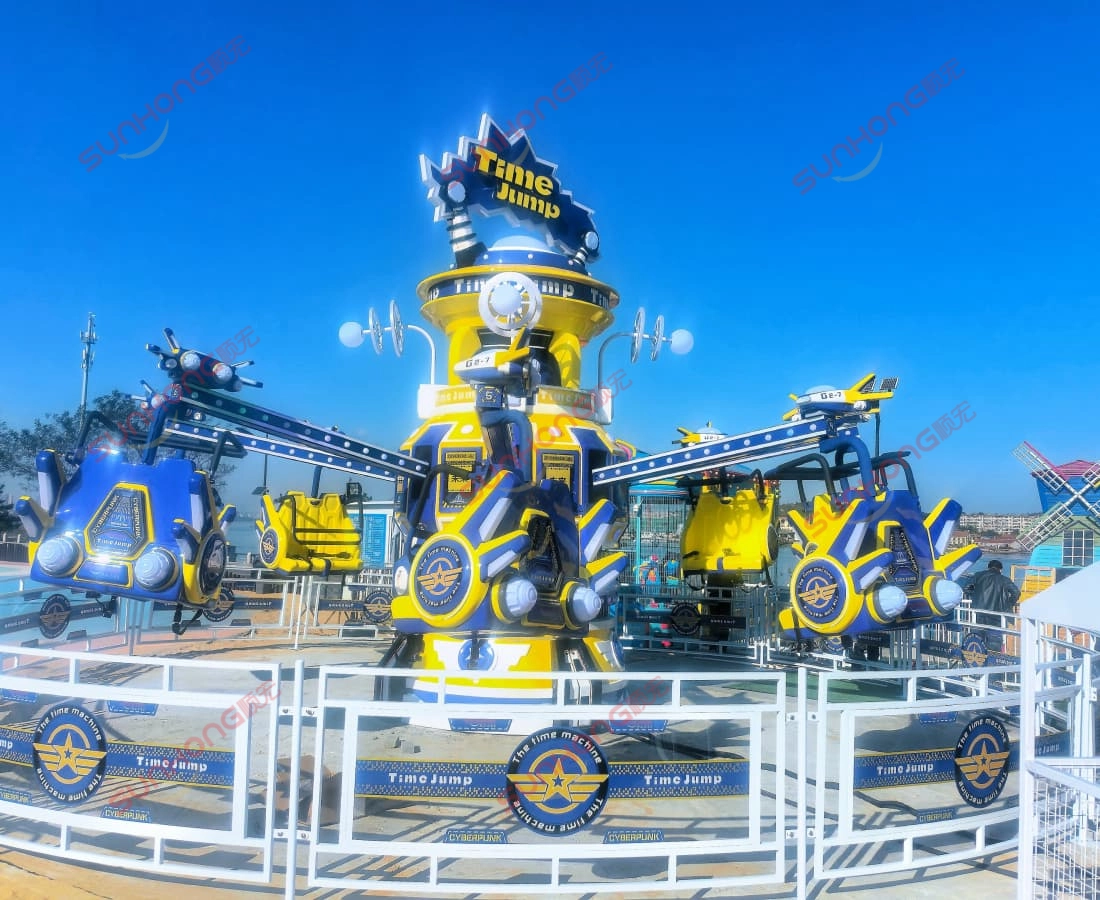
16-Seat Time Jump – Rotating Plane Ride for Amusement Parks
Time Jump is a thrilling and cost-effective amusement ride, 100% originally developed and manufactured by SUNHONG with patented certification. Designed for families and children, it combines motor drive and air-compressor cylinders to achieve dynamic movements—left-right rotation, variable-speed spinning, bouncing seats, and full 360-degree spins.
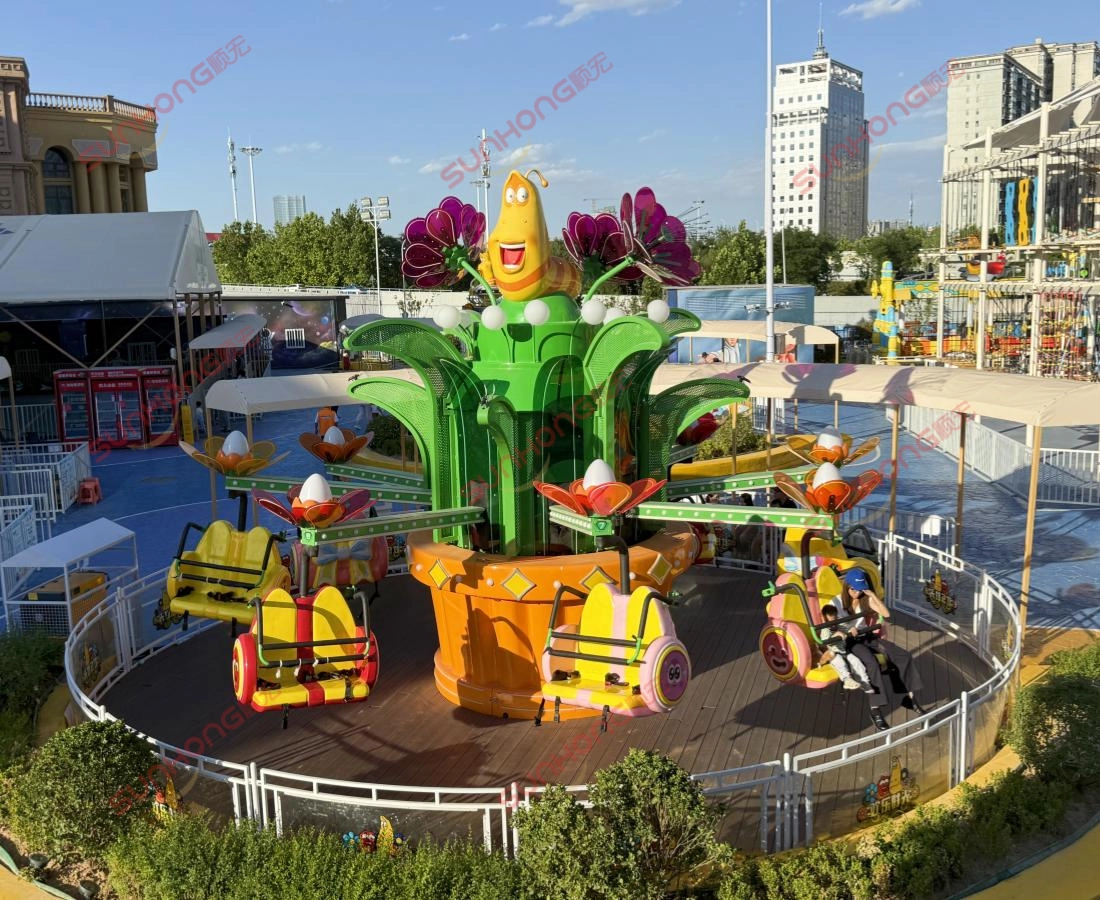
Larva Blooms Bounce Ride – Hot IP Custom Attraction with 360° Spin & Bounce
Larva Blooms is a patented bounce ride inspired by the hit Larva animation series. Featuring full platform rotation, 360° spinning seats, and dynamic bouncing motion, it delivers a thrilling ride experience for families and kids. IP customization available with OEM/ODM service.
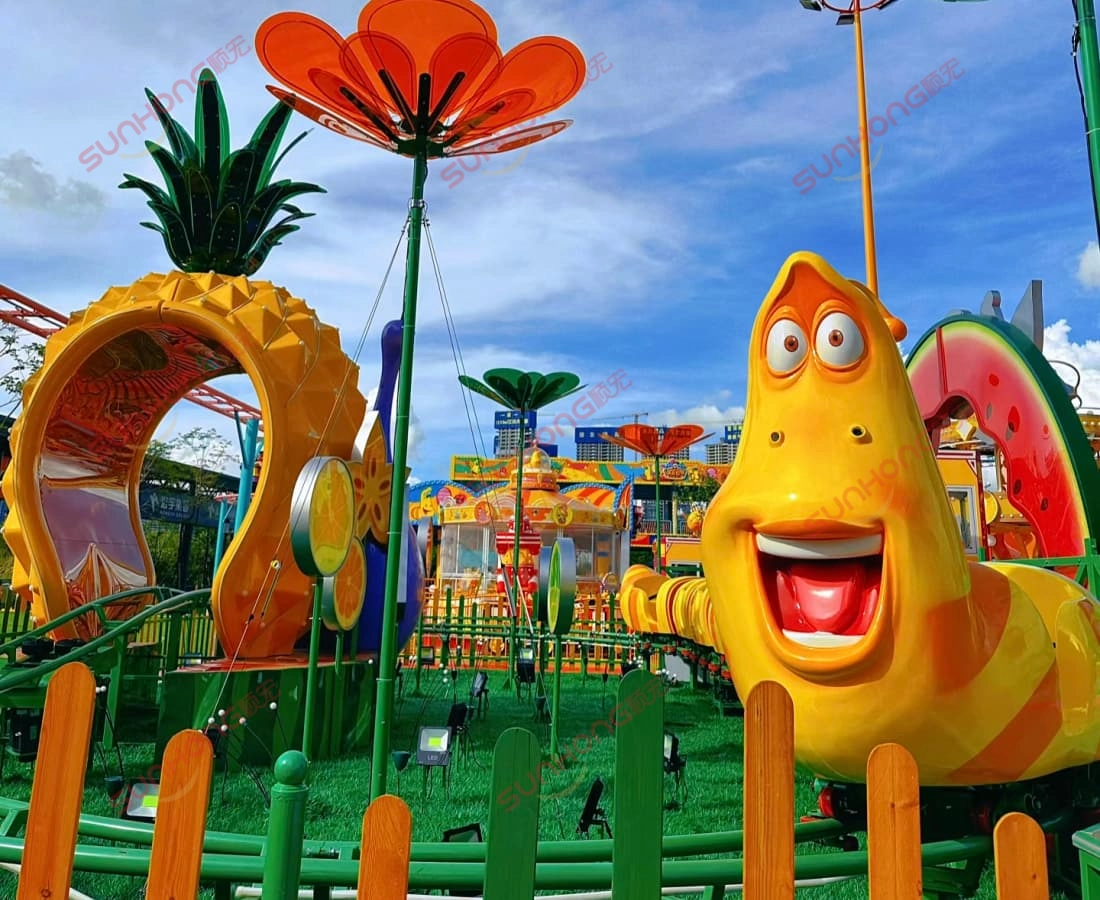
Larva Fruitland – A Mini Roller Coaster Adventure for Kids and Families
Larva Fruitland is a mini roller coaster themed after the Larva animated series. With vibrant colors and gentle motion, it’s perfect for kids and families. This small coaster features IP characters, a fruit farm design, and photo-worthy appeal. Ideal for indoor or outdoor parks. OEM/ODM customization available for your branding needs.

360 Degree Rotating Ride Swing Thrill Amusement Rides for Attractions
Air Bus is a stunning addition to our family amusement rides, delivering a one-of-a-kind 360° dual-rotation experience. With its swinging arm and self-spinning cabin, bright yellow flying-bus design, dynamic music effects, and customizable options, this ride is more than just entertainment—it’s a show-stopping centerpiece that helps your park attract crowds.
Leave a message
Ready to elevate your amusement offerings?
Contact Sunhong today to explore how we can bring your vision to life and create unforgettable experiences for your visitors.
* Rest assured that your privacy is important to us, and all information provided will be handled with the utmost confidentiality.
Copyright © 2025 SUNHONG All Reserved.
Whatsapp: +8613922331804
Guangzhou Shunhong Entertainment Equipment Co.,Ltd.
sunhongrides
SUNHONGAMUSEMENTRIDES
Scan QR Code