
Indoor Playground Equipment vs. Trampoline Park Equipment for Family Entertainment Centers
- How Soft-Play Centers and Trampoline Venues Differ
- Customer demographics and visit purpose
- Space planning and building conditions
- Safety engineering and operating controls
- Commercial Comparison for Investment Planning
- Revenue logic and utilization
- Operational complexity and maintenance
- Comparison table for buyer decisions
- How to Select the Right Attraction Mix
- Evaluate the catchment area and customer journey
- Use a measurable return-on-investment model
- Confirm compliance, documentation, and after-sales support
- Why SUNHONG Supports Integrated Entertainment Projects
- From concept development to completed installation
- Customization, manufacturing control, and global delivery
- Product portfolio and long-term project value
- Frequently Asked Questions
- Which option is better for a first family entertainment venue?
- How much ceiling height does a trampoline park require?
- Can a soft-play area and trampoline zone operate in the same venue?
- What safety documents should buyers request from a manufacturer?
- How can operators control maintenance costs?
- Does SUNHONG provide amusement park design as well as equipment?
Indoor playground equipment and trampoline park equipment are both important categories of family entertainment center equipment, but they create different customer experiences, operational demands, and investment profiles. Soft-play structures are generally better suited to toddlers, preschool children, and mixed-age family visits, while trampoline attractions often generate stronger appeal among school-age children, teenagers, sports groups, and birthday parties. A sound procurement decision should compare age coverage, ceiling height, floor loading, safety systems, staffing, throughput, cleaning, insurance, maintenance, and revenue per square meter rather than choosing purely on visual appeal. Project owners should also evaluate whether a hybrid venue combining climbing, slides, trampolines, toddler zones, party rooms, and other amusement park rides can increase repeat visitation and reduce dependence on one attraction category.
How Soft-Play Centers and Trampoline Venues Differ
Customer demographics and visit purpose
Indoor playgrounds are commonly designed around exploratory play, crawling, climbing, sliding, balancing, and imaginative interaction. Their strongest audience often includes families with children from approximately two to twelve years old, although the final age range depends on the structure, supervision model, and availability of separated toddler areas. Parents may stay on site for extended periods because soft-play environments support free play, social development, and birthday-party programming.
Trampoline parks are more activity-intensive. Open jump courts, dodgeball areas, basketball trampolines, airbag landings, climbing walls, and ninja-style obstacles can attract older children and teenagers who seek physical challenge and social competition. The venue can also sell structured sessions, school trips, team-building events, and fitness-oriented programs. However, the operator must manage participant ability, jump-time scheduling, court density, and collision risk more rigorously.
Space planning and building conditions
A multi-level play frame can use vertical volume efficiently, but it still requires circulation lanes, emergency exits, staff sightlines, impact-absorbing flooring, and sufficient clearance around slides and moving components. Trampoline installations usually demand greater clear height and carefully engineered separation between courts, walls, columns, spectator areas, and ancillary attractions. A building that appears large on a leasing plan may become commercially inefficient after columns, mechanical equipment, fire routes, reception, restrooms, storage, and party rooms are deducted.
Before selecting equipment, the design team should complete a site survey covering structural capacity, slab condition, ceiling obstructions, HVAC performance, electrical supply, fire protection, accessibility, acoustics, and local permitting. A supplier that provides only equipment quotations may leave the buyer with costly coordination gaps. Integrated amusement park design is more effective when equipment dimensions, guest flow, queueing, supervision positions, and building services are resolved together.
Safety engineering and operating controls
Every attraction requires documented risk assessment, installation instructions, inspection routines, staff training, and incident reporting. Soft-play hazards often relate to entrapment points, exposed fasteners, worn padding, loose netting, falls from height, and poor separation between age groups. Trampoline facilities add risks associated with simultaneous jumping, awkward landings, court boundaries, wall contact, foam-pit entry, and insufficient participant screening.
Buyers should request technical drawings, material specifications, load assumptions, cleaning instructions, replacement-part schedules, and evidence that the design is aligned with applicable local requirements. The U.S. Consumer Product Safety Commission trampoline guidance provides useful risk context, while the ASTM F2970 standard for trampoline courts is a relevant technical reference for commercial trampoline facilities. These references do not replace local legal review, professional installation, or an attraction-specific safety assessment.
Commercial Comparison for Investment Planning
Revenue logic and utilization
Soft-play venues can support open admission, timed entry, memberships, school visits, parent-child programs, cafés, retail sales, and birthday packages. Their broad family appeal may help fill weekday daytime periods, especially when a venue is located near residential communities, shopping centers, or schools. Revenue is influenced by capacity, visit duration, party-room utilization, food-and-beverage conversion, and repeat membership behavior.
Trampoline parks can achieve strong revenue from timed jump sessions, High Quality attractions, group bookings, parties, camps, and special events. Their commercial strength depends on reliable session turnover and high utilization during after-school hours, weekends, and holidays. Since intensive activity can increase equipment wear and cleaning requirements, financial models should include downtime, mat replacement, padding inspection, labor, liability coverage, and periodic refurbishment.
Operational complexity and maintenance
Soft-play maintenance requires frequent visual inspections, tightening or replacement of fasteners, sanitation of high-touch surfaces, repair of foam and vinyl components, netting checks, and monitoring of slides and climbing elements. Trampoline parks require systematic inspection of jumping mats, springs or modular components, frame padding, net systems, court dividers, landing zones, and activity-specific equipment. Both formats need documented opening and closing checklists, but trampoline operations generally require more active session control.
Cleaning should be treated as a design requirement rather than an afterthought. Smooth, cleanable surfaces, accessible service zones, replaceable upholstery, drainage planning, and material resistance to disinfectants can reduce long-term operating costs. The World Health Organization explains the importance of appropriate cleaning and disinfection practices in public environments through its environmental cleaning and disinfection guidance. Operators should adapt any public-health guidance to local rules and the specific materials used in the attraction.
Comparison table for buyer decisions
| Decision factor | Indoor soft-play system | Commercial trampoline system | Procurement implication |
|---|---|---|---|
| Primary audience | Toddlers, young children, and families | School-age children, teenagers, groups, and active adults | Match the attraction to local demographics and catchment-area demand |
| Typical activity | Climbing, crawling, sliding, balancing, and imaginative play | Jumping, aerial movement, dodgeball, basketball, and obstacle challenges | Higher-intensity activities require stronger session controls and supervision |
| Building sensitivity | Important floor area, circulation, and sightlines | High ceiling clearance, structural coordination, and court separation | Complete a measured site survey before final quotation |
| Revenue extensions | Memberships, cafés, parties, camps, and toddler sessions | Timed sessions, parties, group events, camps, and High Quality zones | Model ancillary revenue separately from admission sales |
| Maintenance focus | Padding, netting, fasteners, surfaces, and hygiene | Mats, springs or modules, padding, nets, frames, and landing areas | Budget inspection labor, spare parts, and planned refurbishment |
| Reference framework | Local playground and public-use requirements | ASTM F2970 and applicable local requirements | Standards are a starting point and do not replace local compliance review |
How to Select the Right Attraction Mix
Evaluate the catchment area and customer journey
Demand analysis should include household composition, school density, tourism patterns, competing venues, average disposable income, transport access, parking, and seasonal variation. A venue near family housing may prioritize toddler play, soft-play climbing, and café visibility. A destination near universities, sports facilities, or entertainment districts may obtain stronger returns from trampolines, ninja courses, interactive games, and competitive activities.
The guest journey should be mapped from arrival to departure. Reception, shoe storage, ticketing, briefing areas, spectator seating, party rooms, toilets, food service, retail, and exit circulation all affect perceived quality. Parents value clear visibility, comfortable seating, hygiene, and reliable communication, while children respond to novelty, challenge, color, movement, and themed storytelling. A balanced layout can serve both audiences without allowing one activity to compromise another.
Use a measurable return-on-investment model
A credible feasibility model should calculate usable sellable area, maximum simultaneous capacity, average admission price, utilization by daypart, party conversion, membership revenue, food-and-beverage spend, labor cost, rent, utilities, insurance, marketing, repairs, depreciation, and expected replacement cycles. The model should also test conservative, base, and optimistic scenarios. High theoretical capacity does not guarantee high revenue if the attraction is difficult to supervise, uncomfortable for parents, or poorly matched to the local market.
Procurement teams should compare total cost of ownership rather than the factory price alone. Important variables include design revisions, freight, customs, installation, local contractors, commissioning, training, spare parts, warranty response, compliance documentation, and future expansion. A modular product architecture can be valuable because it allows operators to refresh a play environment or add a new activity without rebuilding the entire facility.
Confirm compliance, documentation, and after-sales support
Supplier due diligence should cover legal company identity, manufacturing capacity, quality-control procedures, project references, drawings, material certificates, inspection records, installation method statements, warranty terms, and service response times. The ISO 9001 quality management principles are useful when assessing whether a manufacturer has repeatable processes for design control, production, corrective action, and customer satisfaction.
Buyers should also distinguish between a certificate for a material or component and full compliance of a complete installed attraction. Local authorities may require fire, building, electrical, accessibility, occupational safety, or amusement-device documentation. Early review with consultants, insurers, landlords, and regulators can prevent redesign after production has started.
Why SUNHONG Supports Integrated Entertainment Projects
From concept development to completed installation
SUNHONG is a large-scale comprehensive amusement ride manufacturer dedicated to research and development, design, manufacturing, and sales. Our team supports overall planning, R&D design, exclusive customization, production, comprehensive construction, and operation management. This integrated structure helps project owners coordinate the attraction concept, guest circulation, visual identity, equipment configuration, and implementation schedule through one experienced partner.
Our in-house R&D, production, and construction teams provide services from the initial concept to final project completion. For a family-oriented venue, the design can combine soft-play structures, trampoline zones, climbing elements, interactive attractions, party areas, and selected amusement park rides according to the building, budget, target age groups, and operating strategy. This approach helps reduce the risk of purchasing disconnected products that later create problems with circulation, supervision, or theming.
Customization, manufacturing control, and global delivery
Every commercial site has different constraints. SUNHONG can develop customized amusement park equipment around available floor area, ceiling height, architectural columns, brand colors, local culture, desired capacity, and expansion plans. Our manufacturing process is supported by engineering coordination and production management intended to maintain consistency between approved drawings and delivered components.
With more than ten years of export experience, SUNHONG has supported projects across international markets. The company holds certificates and market-entry qualifications for destinations including CE for the European Union, UKCA for the United Kingdom, SABER for Saudi Arabia, TÜV-related documentation for Germany, and ASTM certification for the United States, subject to product scope and applicable project requirements. SUNHONG amusement rides have been installed in more than 56 nations and regions, giving international buyers a practical basis for evaluating export coordination and site implementation capability.
Product portfolio and long-term project value
Our portfolio includes amusement park equipment, custom amusement park design, and amusement park ride solutions for indoor and outdoor entertainment projects. The objective is not simply to supply visually attractive components; it is to create an operating environment that supports safe guest flow, memorable experiences, efficient staffing, maintainable materials, and scalable commercial performance.
Project owners considering a soft-play center, trampoline venue, or hybrid family attraction should provide a site plan, building dimensions, target market, preferred theme, estimated investment, and expected opening date during the consultation stage. SUNHONG can then help evaluate the attraction mix, develop preliminary layouts, prepare technical proposals, coordinate manufacturing, and organize construction support. Our long-term goal is to become a leading global amusement ride manufacturer while helping investors and distributors deliver dependable entertainment destinations in their local markets.
Frequently Asked Questions
Which option is better for a first family entertainment venue?
Indoor soft-play equipment is often easier to position for broad family demand, while trampoline equipment can deliver strong appeal to older children and group customers. The better option depends on local demographics, building height, competition, staffing, insurance, and the planned revenue mix. A feasibility study should compare both options using realistic utilization assumptions.
How much ceiling height does a trampoline park require?
There is no single universal height because requirements vary by attraction type, manufacturer design, local code, and clearance needed above participants. Buyers should obtain a project-specific section drawing and have the building reviewed by qualified structural, fire, and safety professionals before signing a lease or approving production.
Can a soft-play area and trampoline zone operate in the same venue?
Yes. A hybrid layout can broaden the age range and create multiple revenue streams, provided that the zones are physically separated, appropriately supervised, and supported by clear rules and circulation. Toddler areas should be protected from high-energy activities, and the operating plan should control access according to age, height, ability, and session type.
What safety documents should buyers request from a manufacturer?
Buyers should request technical drawings, risk assessments, material and component specifications, installation instructions, inspection checklists, maintenance schedules, warranty terms, training materials, and applicable certificates. Documentation should be reviewed against local building, fire, accessibility, occupational safety, and amusement requirements rather than accepted without professional verification.
How can operators control maintenance costs?
Maintenance costs can be controlled through durable materials, accessible service points, documented daily inspections, scheduled preventive maintenance, trained staff, spare-part planning, and prompt repair of minor damage. Buyers should confirm which components are replaceable, how quickly parts can be supplied, and whether the supplier provides technical support after installation.
Does SUNHONG provide amusement park design as well as equipment?
Yes. SUNHONG provides overall planning, customized design, amusement equipment manufacturing, comprehensive construction, and operation-management support. The in-house R&D, production, and construction teams can coordinate a project from concept development through completion, including solutions for indoor playgrounds, trampoline areas, hybrid entertainment centers, and other amusement attractions.
Timeline benchmarks: design, manufacture, install, open
Ride selection guide by park size and target audience
Customizable Kiddie Rides: Branding and Theming Tips
How to Select High-ROI Equipment for a New Family Entertainment Center
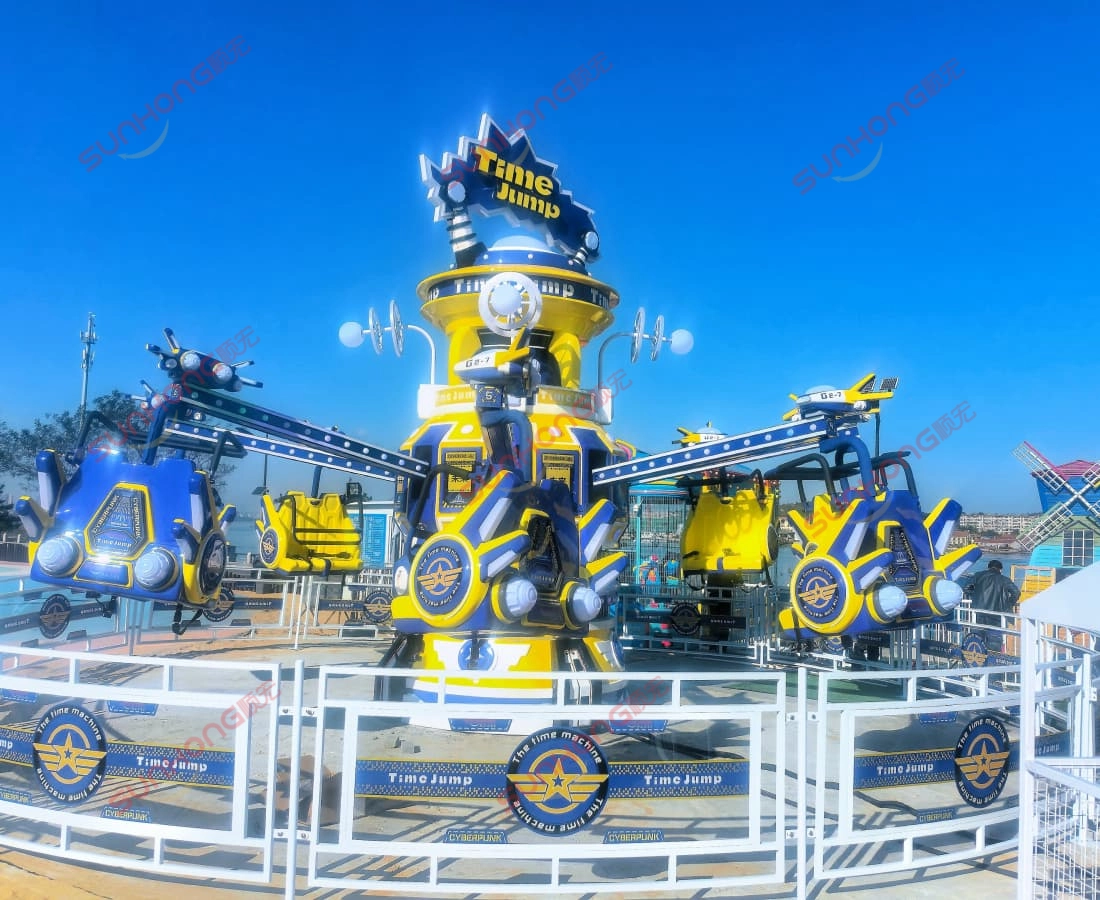
16-Seat Time Jump – Rotating Plane Ride for Amusement Parks
Time Jump is a thrilling and cost-effective amusement ride, 100% originally developed and manufactured by SUNHONG with patented certification. Designed for families and children, it combines motor drive and air-compressor cylinders to achieve dynamic movements—left-right rotation, variable-speed spinning, bouncing seats, and full 360-degree spins.
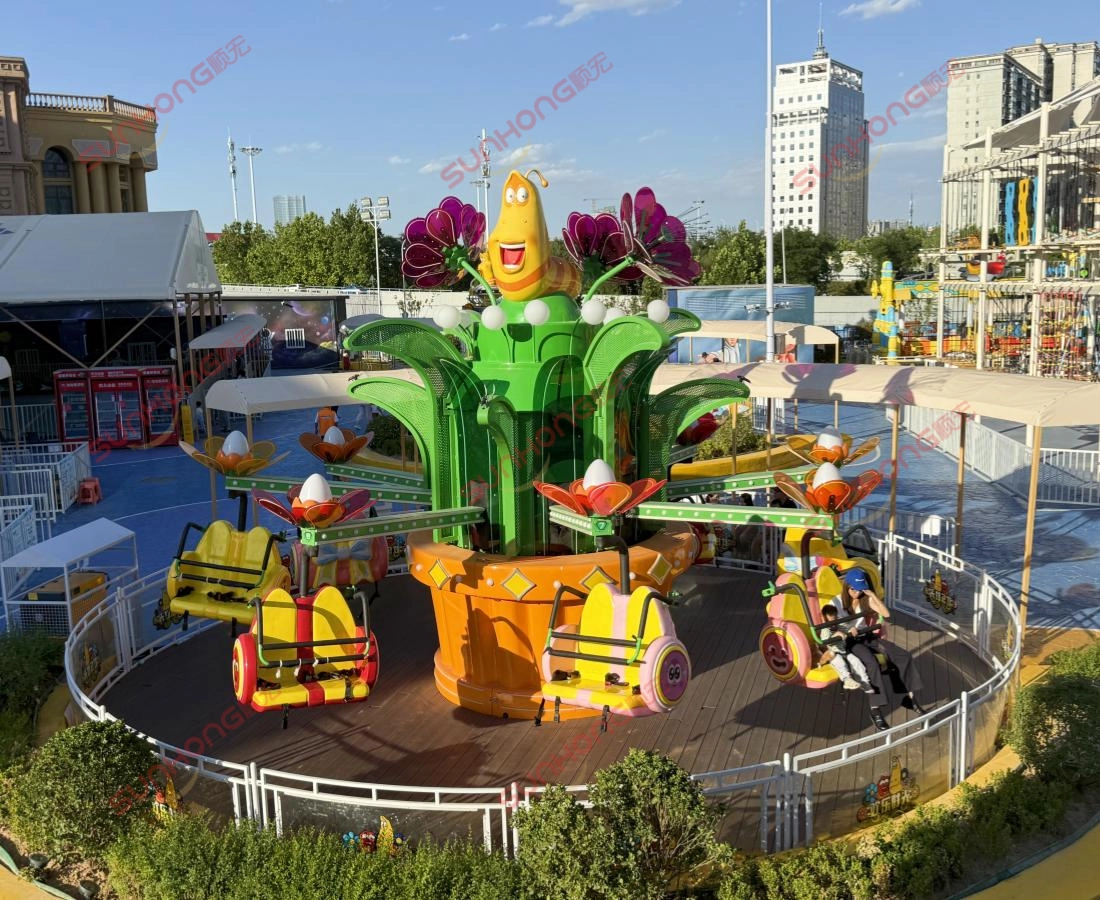
Larva Blooms Bounce Ride – Hot IP Custom Attraction with 360° Spin & Bounce
Larva Blooms is a patented bounce ride inspired by the hit Larva animation series. Featuring full platform rotation, 360° spinning seats, and dynamic bouncing motion, it delivers a thrilling ride experience for families and kids. IP customization available with OEM/ODM service.
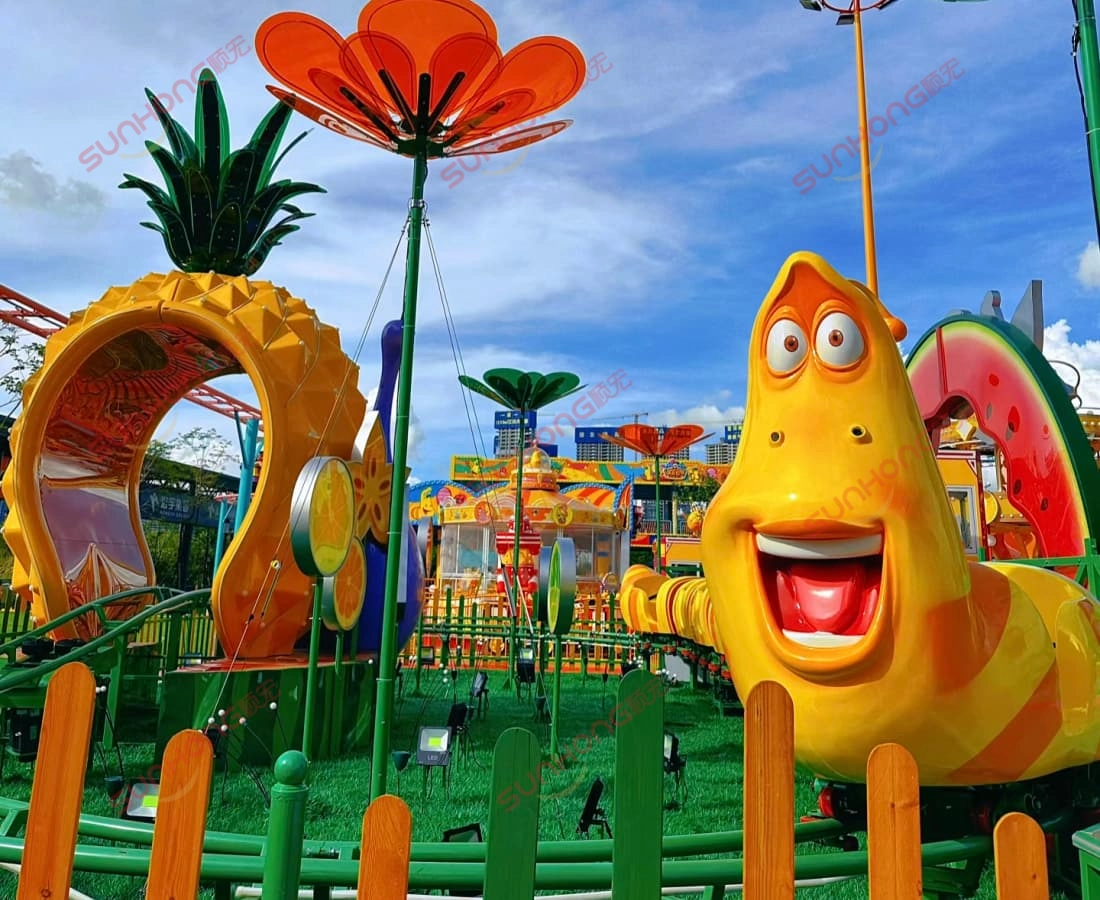
Larva Fruitland – A Mini Roller Coaster Adventure for Kids and Families
Larva Fruitland is a mini roller coaster themed after the Larva animated series. With vibrant colors and gentle motion, it’s perfect for kids and families. This small coaster features IP characters, a fruit farm design, and photo-worthy appeal. Ideal for indoor or outdoor parks. OEM/ODM customization available for your branding needs.

360 Degree Rotating Ride Swing Thrill Amusement Rides for Attractions
Air Bus is a stunning addition to our family amusement rides, delivering a one-of-a-kind 360° dual-rotation experience. With its swinging arm and self-spinning cabin, bright yellow flying-bus design, dynamic music effects, and customizable options, this ride is more than just entertainment—it’s a show-stopping centerpiece that helps your park attract crowds.
Leave a message
Ready to elevate your amusement offerings?
Contact Sunhong today to explore how we can bring your vision to life and create unforgettable experiences for your visitors.
* Rest assured that your privacy is important to us, and all information provided will be handled with the utmost confidentiality.
Copyright © 2025 SUNHONG All Reserved.
Whatsapp: +8613922331804
Guangzhou Shunhong Entertainment Equipment Co.,Ltd.
sunhongrides
SUNHONGAMUSEMENTRIDES
Scan QR Code